


Group 103 (1)
Mask group (1)

YESAFILI is just as safe and effective as Eylea1

YESAFILI is indicated for the treatment of1:

  • Neovascular (Wet) Age-Related Macular Degeneration (AMD)
  • Macular Edema following Retinal Vein Occlusion (RVO)
  • Diabetic Macular Edema (DME)
  • Diabetic Retinopathy (DR)

A clear difference in pre-filled syringe

YESAFILI is available as a single-dose pre-filled syringe as well as a single-dose glass vial.1
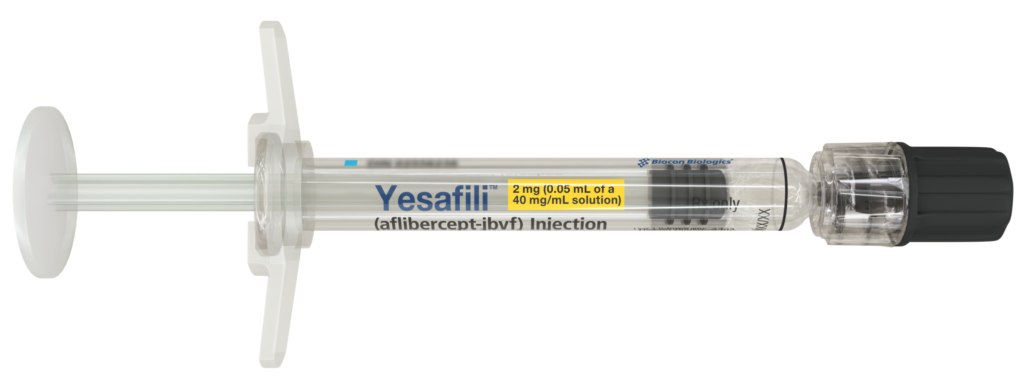
Yesafili_Syringe_US_TM_032726_50_RGB

YESAFILI Gx® BAKED-ON RTF® GLASS SYRINGE

Baked-on Silicone Oil

Minimizes its potential release3

Large Thumb Rest


Improves control while you inject3

72 Hours

Allows up to 3 days outside of the fridge1

Low Break-Loose Force

Provides smooth gliding
during injection3

RTF=ready-to-fill.

How YESAFILI is administered

YESAFILI is administered with the same dosing schedules as

Eylea 2 mg (0.05 mL of 40 mg/mL) solution across approved indications.1

Indications1WET AMD*RVODME & DR
YESAFILI1Every 4 weeks for first

3 injections, then every 8 weeks
Every 4 weeksEvery 4 weeks for first

5 injections, then every 8 weeks
*Although YESAFILI may be dosed as frequently as 2 mg every 4 weeks (approximately every 25 days, monthly), additional efficacy was not demonstrated in most patients when aflibercept was dosed every 4 weeks compared to every 8 weeks. Although not as effective as the recommended every 8 week dosing regimen, patients may also be treated with 1 dose every 12 weeks after 1 year of effective therapy. Patients should be assessed regularly.Although YESAFILI may be dosed as frequently as 2 mg every 4 weeks (approximately every 25 days, monthly), additional efficacy was not demonstrated in most patients when aflibercept was dosed every 4 weeks compared to every 8 weeks.
Indications1YESAFILI1
WET AMD*Every 4 weeks for first 3 injections, then every 8 weeks
RVOEvery 4 weeks
DME & DREvery 4 weeks for first 5 injections, then every 8 weeks

Highly similar clinical profile3,4

Click to see the full clinical data from a Phase 3, multicenter, randomized, double-blind clinical study.

Group 103
Mask group

Highly similar clinical profile3,4

Click to see the full clinical data from a Phase 3, multicenter, randomized, double-blind clinical study.

Mask group

We’re focused on zero disruptions to your routine

The My Biocon Biologics® Patient Support Program offers specialized assistance to your patients and practice.

Coding and Billing

The Coding Tip Sheet is a reference tool for on-demand coding tips.

Download the Coding Tip Sheet.download

The Coding and Billing Guide provides more detailed information.

BenefitS Investigation

Receive help with patient-specific insurance coverage.
Gain support managing cost-sharing complexities, including coinsurance and out-of-pocket maximums.

Prior authorization assistance

Obtain assistance with requirements and submission details, and status tracking.

FIELD REIMBURSEMENT MANAGER (FRM)

This dedicated team of specialists provides guidance on reimbursement, billing, and access assistance. Choose the most convenient option for your practice to get started:

  1. Contact Your Rep
    Reach out directly to your Biocon Territory Account Manager to request FRM support.
  2. Call the My Biocon Biologics Support Team
    Reach a Representative at 1-833-612-4626.
  3. Download & Fax
    Download the request form and submit it via fax to 1-833-726-4848.

COPAY SUPPORT

We'll help you identify and enroll your eligible patients who may pay as little as $0 in out-of-pocket costs.* *Eligibility restrictions apply. Not valid for uninsured patients or patients who are covered by a state- or federally funded healthcare program. For full terms and conditions, visit www.Yesafili.com/copay.

YESAFILI has been assigned the HCPCS Level II Product Code of Q5155.

Visit our HCP Support Portal to enroll patients or sign up for copay support.
There are 3 convenient ways to begin.

Find YESAFILI on
PX Connect

Fax Enrollment Form

Eligibility requirements apply.
Asset 1 1

Our specialists can provide support including patient benefits verification and more

Icons

Help is available Monday-Friday 8 AM-8 PM ET—just call 1-833-612-4626

Biocon logo
We know biosimilars like you know eyes5

With nearly 50 years of experience, Biocon Biologics is leading the way as a top 15 global leader in manufacturing biosimilars. Every day, our affordable and innovative therapies deliver new possibilities in diabetes, oncology, immunology, bone health, and, of course, ophthalmology.

By ensuring the long-term stability of biosimilars, Biocon Biologics is building a more sustainable future for millions of patients who will benefit from affordable access to these lifesaving therapies.

IN 2024 ALONE

$20.2 BILLION SAVED5
SINCE 2015
$56.2 BILLION SAVED5
Sign up to receive updates and
more information about YESAFILI.

*Required fields. 

REFERENCES

1. YESAFILI. Prescribing information. Biocon Biologics Inc; 2026. 2. US Food and Drug Administration. Yesafili BLA approval letter: BLA 761274. May 20, 2024. Accessed April 14, 2026. https://www.accessdata.fda.gov/drugsatfda_docs/appletter/2024/761274Orig1s000ltr.pdf 3. Data on file. Biocon Biologics; 2026. 4. EYLEA. Prescribing information. Regeneron Pharmaceuticals, Inc; 2024. 5. Biocon. Accelerating Reach: Integrated Annual Report FY 2025. Biocon Limited. Accessed February 24, 2026. https://www.biocon.com/docs/Biocon_Integrated_Annual_Report_2025.pdf

IMPORTANT SAFETY INFORMATION AND INDICATIONS

READ MORE +

SHOW LESS -

IMPORTANT SAFETY INFORMATION

CONTRAINDICATIONS

  • YESAFILI (aflibercept-jbvf) is contraindicated in patients with ocular or periocular infections, active intraocular inflammation, or known hypersensitivity to aflibercept or to any of the excipients in YESAFILI.

WARNINGS AND PRECAUTIONS

  • Intravitreal injections, including those with aflibercept products, have been associated with endophthalmitis and retinal detachments and, more rarely, retinal vasculitis with or without occlusion. Proper aseptic injection technique must always be used when administering YESAFILI. Patients and/or caregivers should be instructed to report any signs and/or symptoms suggestive of endophthalmitis, retinal detachment, or retinal vasculitis without delay and should be managed appropriately.
  • Acute increases in intraocular pressure have been seen within 60 minutes of intravitreal injection, including with aflibercept products. Sustained increases in intraocular pressure have also been reported after repeated intravitreal dosing with VEGF inhibitors. Intraocular pressure and the perfusion of the optic nerve head should be monitored and managed appropriately.
  • There is a potential risk of arterial thromboembolic events (ATEs) following intravitreal use of VEGF inhibitors, including aflibercept products. ATEs are defined as nonfatal stroke, nonfatal myocardial infarction, or vascular death (including deaths of unknown cause).
  • The incidence of reported thromboembolic events in wet AMD studies during the first year was 1.8% (32 out of 1824) in the combined group of patients treated with aflibercept compared with 1.5% (9 out of 595) in patients treated with ranibizumab; through 96 weeks, the incidence was 3.3% (60 out of 1824) in the aflibercept group compared with 3.2% (19 out of 595) in the ranibizumab group. The incidence in the DME studies from baseline to week 52 was 3.3% (19 out of 578) in the combined group of patients treated with aflibercept compared with 2.8% (8 out of 287) in the control group; from baseline to week 100, the incidence was 6.4% (37 out of 578) in the combined group of patients treated with aflibercept compared with 4.2% (12 out of 287) in the control group. There were no reported thromboembolic events in the patients treated with aflibercept in the first six months of the RVO studies.

ADVERSE REACTIONS

  • Serious adverse reactions related to the injection procedure have occurred in <0.1% of intravitreal injections with aflibercept including endophthalmitis and retinal detachment.
  • The most common adverse reactions (≥5%) reported in patients receiving aflibercept were conjunctival hemorrhage, eye pain, cataract, vitreous detachment, vitreous floaters, and intraocular pressure increased.
  • Patients may experience temporary visual disturbances after an intravitreal injection with YESAFILI and the associated eye examinations. Advise patients not to drive or use machinery until visual function has recovered sufficiently.
  • Patient may experience eye disorders such as retinal vasculitis and occlusive retinal vasculitis related to intravitreal injection with aflibercept.

INDICATIONS

YESAFILI is a vascular endothelial growth factor (VEGF) inhibitor indicated for the treatment of patients with:

  • Neovascular (Wet) Age-Related Macular Degeneration (AMD)
  • Macular Edema following Retinal Vein Occlusion (RVO)
  • Diabetic Macular Edema (DME)
  • Diabetic Retinopathy (DR)

IMPORTANT SAFETY INFORMATION AND INDICATIONS

IMPORTANT SAFETY INFORMATION

CONTRAINDICATIONS

  • YESAFILI (aflibercept-jbvf) is contraindicated in patients with ocular or periocular infections, active intraocular inflammation, or known hypersensitivity to aflibercept or to any of the excipients in YESAFILI.

WARNINGS AND PRECAUTIONS

  • Intravitreal injections, including those with aflibercept products, have been associated with endophthalmitis and retinal detachments and, more rarely, retinal vasculitis with or without occlusion. Proper aseptic injection technique must always be used when administering YESAFILI. Patients and/or caregivers should be instructed to report any signs and/or symptoms suggestive of endophthalmitis, retinal detachment, or retinal vasculitis without delay and should be managed appropriately.
  • Acute increases in intraocular pressure have been seen within 60 minutes of intravitreal injection, including with aflibercept products. Sustained increases in intraocular pressure have also been reported after repeated intravitreal dosing with VEGF inhibitors. Intraocular pressure and the perfusion of the optic nerve head should be monitored and managed appropriately.
  • There is a potential risk of arterial thromboembolic events (ATEs) following intravitreal use of VEGF inhibitors, including aflibercept products. ATEs are defined as nonfatal stroke, nonfatal myocardial infarction, or vascular death (including deaths of unknown cause).
  • The incidence of reported thromboembolic events in wet AMD studies during the first year was 1.8% (32 out of 1824) in the combined group of patients treated with aflibercept compared with 1.5% (9 out of 595) in patients treated with ranibizumab; through 96 weeks, the incidence was 3.3% (60 out of 1824) in the aflibercept group compared with 3.2% (19 out of 595) in the ranibizumab group. The incidence in the DME studies from baseline to week 52 was 3.3% (19 out of 578) in the combined group of patients treated with aflibercept compared with 2.8% (8 out of 287) in the control group; from baseline to week 100, the incidence was 6.4% (37 out of 578) in the combined group of patients treated with aflibercept compared with 4.2% (12 out of 287) in the control group. There were no reported thromboembolic events in the patients treated with aflibercept in the first six months of the RVO studies.

ADVERSE REACTIONS

  • Serious adverse reactions related to the injection procedure have occurred in <0.1% of intravitreal injections with aflibercept including endophthalmitis and retinal detachment.
  • The most common adverse reactions (≥5%) reported in patients receiving aflibercept were conjunctival hemorrhage, eye pain, cataract, vitreous detachment, vitreous floaters, and intraocular pressure increased.
  • Patients may experience temporary visual disturbances after an intravitreal injection with YESAFILI and the associated eye examinations. Advise patients not to drive or use machinery until visual function has recovered sufficiently.
  • Patient may experience eye disorders such as retinal vasculitis and occlusive retinal vasculitis related to intravitreal injection with aflibercept.

INDICATIONS

YESAFILI is a vascular endothelial growth factor (VEGF) inhibitor indicated for the treatment of patients with:

  • Neovascular (Wet) Age-Related Macular Degeneration (AMD)
  • Macular Edema following Retinal Vein Occlusion (RVO)
  • Diabetic Macular Edema (DME)
  • Diabetic Retinopathy (DR)
Scroll to Top

You are now departing from the Yesafili HCP website and redirected to the Biocon Biologics corporate website. Please be aware that the Biocon Biologics corporate website may contain information that varies from the content on the Yesafili HCP website. The website you are about to access is the corporate website located outside of the U.S.
U.S. regulations may not be applicable to the content on this corporate website.

You are now leaving Yesafili HCP, a Biocon Biologics website. The website you are about to access is not owned or controlled by Biocon Biologics Inc.

Biocon Biologics Inc. assumes no responsibility for and makes no warranties or representation of any kind as to the accuracy, currency, or completeness of any information contained in such third-party website, including any third-party social media or mobile application platform. Inclusion of any third-party link on this website does not imply an endorsement or recommendation by Biocon Biologics, and a link to this website from another website does not imply a relationship between Biocon Biologics and any third party. Your use of any such third-party site or platform is at your own risk and will be governed by such third party’s terms and policies (including its privacy policy). Biocon Biologics shall not be liable for any direct, indirect, consequential, incidental or punitive damages arising out of access to, use of, or inability to use such third-party website, or any errors or omissions in the content thereof.

INDICATIONS

YESAFILI is a vascular endothelial growth factor (VEGF) inhibitor indicated for the treatment of patients with:

    • Neovascular (Wet) Age-Related Macular Degeneration (AMD)
    • Macular Edema following Retinal Vein Occlusion (RVO)
    • Diabetic Macular Edema (DME)
    • Diabetic Retinopathy (DR)